

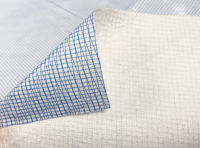
Scrim reinforcement plays a critical role in many laminated materials used across packaging, construction, filtration, and industrial applications. While often hidden inside the finished product, scrim provides the structural backbone that improves strength, stability, and durability. Understanding what a scrim reinforcement is and how it functions helps explain why engineered composite materials perform so well in demanding environments.
What Is a Scrim Reinforcement?
A scrim reinforcement is an open mesh structure embedded within laminated materials to provide structural support. Scrims are typically made from polymers, fiberglass, or other engineered fibers and are designed to distribute loads across the laminate rather than concentrating stress in a single location. Because scrims use an open structure instead of a solid layer, they can add strength without significantly increasing weight or thickness. In many laminated products, the scrim acts as the internal framework that allows films, foils, or papers to perform beyond their standalone capabilities.
How Scrim Reinforcement Works
Scrim reinforcement works by distributing mechanical stress across a network of strands. When a laminated material is placed under tension, pressure, or impact, the scrim spreads the load throughout the structure. This prevents localized failure and reduces the likelihood of tearing or puncture damage. Instead of relying solely on thicker materials, manufacturers can achieve higher performance by incorporating an engineered scrim that improves overall structural integrity.
Strength Without Excess Material
One of the key advantages of scrim reinforcement is that it allows laminated materials to achieve strength without relying on excessive thickness. Traditional approaches often increase material gauge to improve durability, which can add weight and reduce flexibility. Scrim structures provide reinforcement through strand orientation and load distribution, allowing laminates to remain lightweight while still delivering strong performance.
Improved Tear Resistance
Scrims also improve tear resistance by helping to contain damage once it occurs. When a puncture or cut develops in a non-reinforced film, the tear can spread rapidly. With a scrim embedded in the structure, the strands act as barriers that limit tear propagation and maintain the integrity of the surrounding material.
Dimensional Stability in Converting
In converting environments where materials pass through laminators, slitters, and rewinders under tension, dimensional stability is essential. Scrim reinforcement helps laminated materials maintain consistent shape and alignment during production. This stability improves runnability and helps converters maintain quality and efficiency in high-speed manufacturing environments.
Applications Across Multiple Industries
Scrim reinforced laminates are used in a wide range of industries where durability and performance are required. In construction, scrims reinforce house wraps, vapor barriers, and roofing materials. In packaging, scrims strengthen films and flexible materials used for containment and transport. Filtration systems often rely on scrims to support filter media and maintain airflow structures. Industrial composites also use scrim reinforcement to improve strength while maintaining flexibility and lightweight design.
Engineered Scrim Materials
Modern scrims are often engineered to provide specific performance characteristics such as strength, openness, flexibility, and compatibility with lamination processes. Materials like CLAF® use oriented polymer structures to create strong, consistent mesh patterns designed for demanding composite applications. These engineered scrims help manufacturers achieve performance improvements while maintaining efficiency in production.
Why Scrim Reinforcement Matters
As industries continue to demand stronger, lighter, and more durable materials, scrim reinforcement has become a fundamental component of modern laminated structures. By distributing stress, improving tear resistance, and stabilizing materials during manufacturing, scrims enable laminates to perform beyond what traditional materials alone could achieve.